
“So much of our courage stems from a sense of shame.”
We live in interesting times — times far removed from the confounding depths of the Congo portrayed in Heart of Darkness, a work heavily referenced in this homage to the destructive nature of the West’s technological, ideological, and colonial incursions into other cultures. But in Twist, Colum McCann explores the vast network of globalization through the lens of the same themes that once represented the literal horrors of the unknown. In McCann’s version, however, the defamiliarization lies not in darkness, but in the vapid electric light of total exposure and the terrifying possibility that there may be absolutely nothing there.
“So much of who we are is who we cannot be. We flatter ourselves when we think we can become something entirely new.”
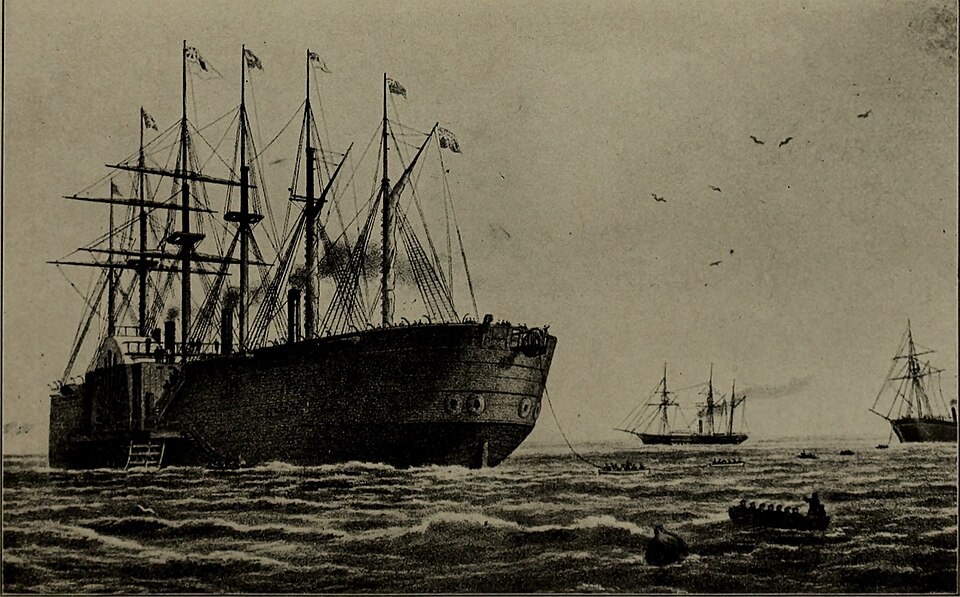
Anthony Fennell, a failed playwright, travels to the west coast of Africa to board a vessel that embarks on months-long excursions repairing the twisted underwater fiber-optic cables that cross the Atlantic. He becomes obsessed with the enigmatic captain, John Conway, a lifelong sailor trapped in a tumultuous and fleeting marriage to a famous actress who suffers a very public attack that takes the internet by storm. Fennell spends much of the novel in pursuit of this Conradian, Kurtz-like figure as Conway pontificates on what our public, private, and interconnected lives become when everything is shared so wildly and willingly with the world at the speed of light.
“I wrote the lines, chopped them, razored them, turned them inside out. The cloud lives under the sea. The light bouncing through the wire—billions of pulses per second—has met a sudden and sharp darkness. Everything, in this exponential age, depends on speed. The idea was to get the boat out of the port and then turn to the wider world of the fiber optics. I got a couple of phone interviews under my belt, and it felt to me as if the piece had enough muscle and sinew to start putting it together. It wasn’t too much of a stretch to remember that in Frankenstein Mary Shelley wrote that the fallen angel becomes the malignant devil.”
It is a relatively short novel and the second of McCann’s works that I have read. Let the Great World Spin is an incredible revelation about the connectedness of humanity, and in many ways, this book feels like its inverse. It is a deeply atmospheric novel focused on twisting and weaving in every sense: the cables themselves, our connections to one another, the construction of stories and identities, and — like the ruptured cables the crew seeks to repair — the gradual unraveling of all of it in the search for meaning and connection, both of which seem to drift further out of reach as time marches on.
“All of us live in at least two worlds. I now know exactly what it was like for Sheen when he caught sight of himself in that mirror. The sweat poured down his face, his chest, his balls. He drew his fist back. His mind processed the gulf between himself and his reflection. His body calculated the distance. His fist whipped through the air and his mind was precisely aware of when the body should stop, but nothing stopped, neither mind nor body, and he drove his fist through his reflection. It was a standing mirror, a vanity, and it rocked a little, as if surprised. It wasn’t just a touch against the glass. It was a punch that wanted to go beyond itself, into those places where it had come from, the boy the man the actor, those places he had been, those places he hated, the person he once was, the memories he now despised. I could see the night sea out the window and my own reflection, and I wanted nothing other than to shatter that too. When I hit the glass, it vibrated as if a little amused. I hit it again. It wobbled. The frame of the window let out a low moan. The glass settled. The reflection shimmered. The yearning distance remained. I waited for the blood from my knuckles, but it did not come. I leaned against the mocking glass, face-to-face, the green eyes, the gray eyes, and the seascape quivered out there beyond us, reliably distant, the splash of waves, the piss of light from the moon, the drift of smoke from the hill. I turned around and went back to my table, but I could still see the seam of the dunes, the torn fence, the grass bent by dogs, the veranda the metal chair forlorn on the lawn, the plate glass window, the leak of light across the floor from my computer, which I absolutely wanted to smash, but knew I wouldn’t.“
It is a brief, beautiful novel, subtle in its exploration of the major psychological anxieties of modern life. Like Heart of Darkness, it operates as a quiet meditation, and McCann proves himself an adept storyteller clearly channeling his admiration for Joseph Conrad throughout the piece. To sustain narrative momentum in such an introspective story — a man chasing an enigmatic captain across the sea — while maintaining gorgeous prose and granite-solid characters is an achievement in itself. It is no easy task for a novel so internal in nature, and McCann executes it masterfully.
“You can ache for years and not even know that you’ve been aching. The ache has gone so deep that it seems to come from another life, one not even remembered anymore. Then, when it spins back up in your mind, you can choose to shove it back down into the territory of a deeper ache, or you can try to coax it into some sort of meaning. I crossed toward her and she half embraced me. She held the camera out and clicked the button. “I’ll send it to you immediately,” she said. Take a hair from your head. Better still, an eyelash. Study it. That is the width of the glass tube that carried the photo that Zanele took, the same one I sent later that evening to my son to tell him that I was on my way to Santiago. The tubes are tiny. They are hollow. They weigh nothing. All they carry is light. I still can’t presume to explain this. It is one of the things that continue to fill me with wonder.”


