
“Allie, don’t let me disappear.”
Today marks the seventy-fifth anniversary of the publication of The Catcher in the Rye (July 16, 1951). Having recently reread it, I thought today was as good a day as any to finally write down some serious thoughts on the novel.
This is one of those books that people return to over and over again. It is the type of literature we shove down the throats of teenagers already cynical about the world, and one we either love or despise—often for the exact same reasons. During my time in the classroom, I never actually taught this book; it was never part of the specific syllabus I was assigned for my grade levels or subjects, so my relationship with it has always been purely personal. Still, I have always been enthralled by the people I know who pick it up year after year, generally around Christmastime, to revisit Holden’s world and rediscover something about their own past and present.
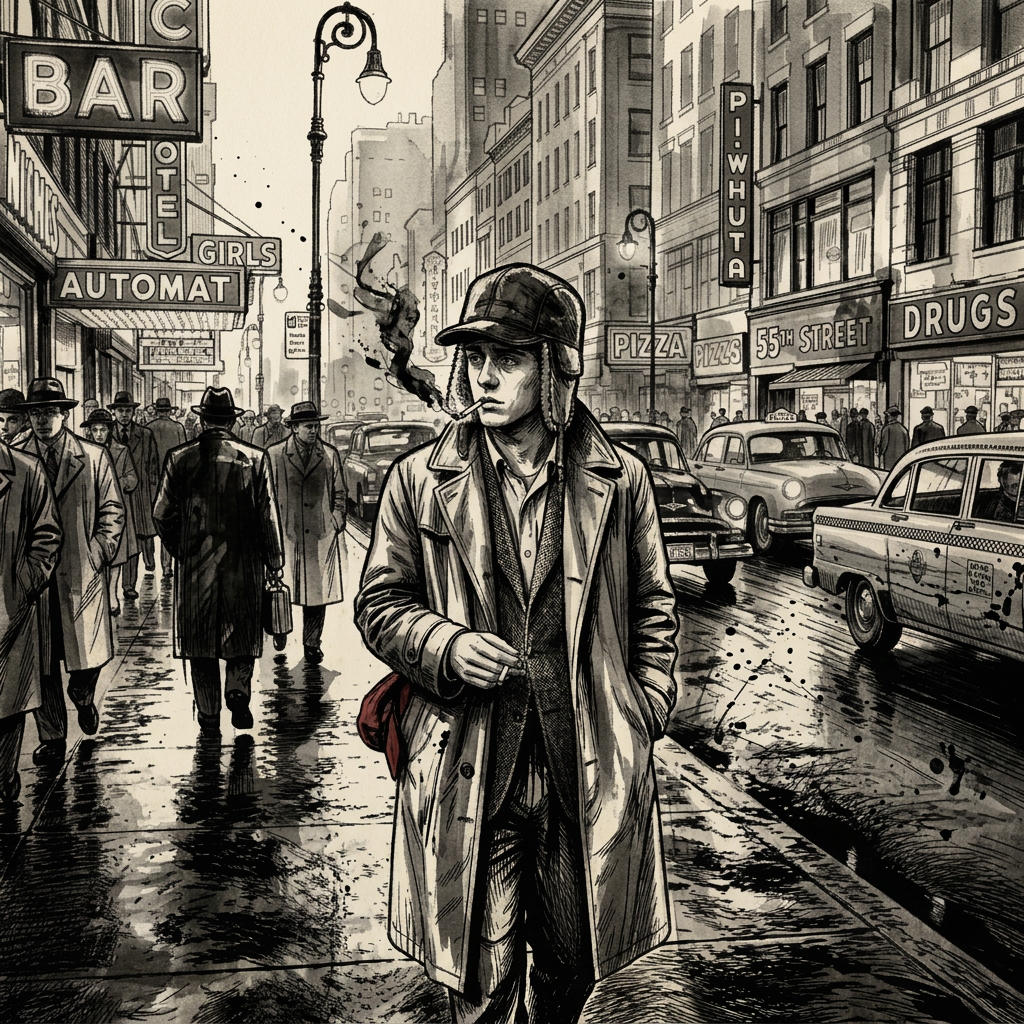
It holds such a deep, reverent place in American society. From direct Hollywood references to its association with infamous crimes, Holden Caulfield is about as cynical as any American character gets. But is he mentally ill? Is he just a confused kid who thinks the world owes him something? Or is he just a nobody “crumb-bum” wandering through a world that utterly baffles him?
The book tells the story of Holden, a kid who is kicked out of his prep school after failing most of his classes. He visits an old history teacher, Mr. Spencer, who tries to offer guidance; he has a terrible date with Sally Hayes, a girl he likes but constantly fumbles with and criticizes; he tries to “become a man” with a prostitute named Sunny but fails to figure out how to pay her for not having sex, resulting in a beating from her pimp; he reconnects with another teacher, Mr. Antolini; and then he slips back home early to visit his little sister, Phoebe, without their parents’ knowledge.
That is really the extent of the story beats. It is easy to see why no film adaptation exists—not much actually happens. Instead, everything is filtered through Holden’s eyes, giving us his deeply colored interpretation of events. But in a sense, we are being misdirected. These events, narrated beautifully and with sharp realism, are entirely shaped by his trauma. He wants to be the “catcher in the rye”—the savior of all children, preventing them from running through the tall grass only to fall off a cliff like lemmings. He wants someone to be there, to do something, in a way no one has ever done for him.
When I first read this as a young adult—the last time being over two decades ago—I experienced it the same way many young people do. The quotes that jumped out at me were the ones that sparked my antisocial, anarchistic side. I was convinced I would change the world, start revolutions, and make the old conservative guard fear my ideas. Yeah, Holden, I thought, it’s true: “all morons” DO “hate it when you call them a moron.” Man, people can be so phony. You might as well tell them, “’glad to’ve met you’ to somebody I’m not at all glad I met.”
Salinger wrote a teenage character with a teenage voice, and it is remarkably easy for any adolescent to read it and instantly validate their own frustration and anger. The era in which the book takes place doesn’t even matter; it will be as timeless in the future as it is now because teenagers cannot escape that developmental rage. Yes, everyone is fake. Yes, the world is ridiculous. Man, how does everyone not absolutely hate Christmas? He’s right!
In subsequent readings, however, the book begins to change. As an adult living in the very same phony, ridiculous world Holden complained about, you realize you aren’t reading the same book anymore.
Because you aren’t the same person.
Consider the moment Mr. Antolini gives Holden advice about the antagonism of youth—one of the most heavily debated passages in the book:
“The mark of the immature man is that he wants to die nobly for a cause, while the mark of the mature man is that he wants to live humbly for one.”
A sixteen-year-old drifter wandering around New York City thirsts to enter the annals of the “27 Club” before such a thing even existed, all to avoid becoming a phony adult. Generations have obsessed over that famous line, “It’s better to burn out than to fade away,” written by Neil Young (or was it Def Leppard? Or was it Kurt Cobain?)
But the thing is, Neil Young sounded a lot like Mr. Antolini when he was interviewed by Dan Rather in 2016. He mentioned that the song was specifically about the spirit of Rock and Roll—Buddy Holly, Cobain, Hendrix, Morrison, Winehouse—getting so close to the edge that when they disappear, “bang,” they are gone at their peak. But Young went on to clarify: that is absolutely not life. Neil Young was only 32 when he wrote “Hey Hey, My My” in 1978, well past that fatal 27-marker. He was 70 during that interview, and has now crossed into being an octogenarian in 2026.
So, what is the book actually about now that I am reading it so many years later? As a man who teaches youth and spends much of my time with modern-day Holdens and Sallys, I don’t think the book is about teenage rebellion at all. In fact, it might only take a second reading to recognize it as a completely different book, and that feeling only intensifies as the years slip away.
Sure, Holden says everyone is phony, but perhaps he is trying to articulate a much harder truth that we only learn later in life: Everyone changes. Everyone leaves. And there is absolutely nothing I can do to stop it. How do I survive that?
Maybe it isn’t that Holden doesn’t care or isn’t paying attention. He even notes that “people never notice anything” because they are so self-absorbed and distracted—an observation that feels even more painfully relevant in 2026. The real issue is that Holden is noticing everything. He is processing and worrying about everyone, especially children, despite being a child himself. He loves Phoebe deeply and wants desperately to protect her. He remembers every detail about everyone, perhaps to a fault. He is utterly devastated by cruelty.
Why? Because he is a deeply empathetic person carrying massive, unhealed wounds.
Holden is a profoundly traumatized kid. There are heavy, dark subtexts to his interactions—including his relationship with his classmates and the true intentions behind Mr. Antolini’s physical touch during his late-night visit. Holden is terrified of violation, noting, “That kind of stuff has happened to me about twenty times since I was a kid. I can’t stand it.”
On top of that, he is actively drowning in grief over his little brother Allie’s death from leukemia at age eleven. It is abundantly clear he has no idea how to process it. How could an exceptionally intelligent, kind, generous, funny, innocent child be struck down by such a cruel universe? And how can Holden live with himself in the aftermath?
Holden’s cynicism is simply a shield. It is deep, raw empathy masquerading as a tough-guy guise because he has no other choice but to see the world through a cracked, dark shit-stained lens. What else is there to do but punch out all the goddamn windows in the garage?
High school students see the rebellious, angry kid and either love him or hate him. Adults see a deeply wounded child carrying a massive burden of grief, alongside physical and emotional scars.
The profound loss of innocence, authenticity, kindness, and ultimately, childhood—that is what this book is truly about. It is a brutally sad commentary on the world we all inherit as we get older. It is devastating to watch a child navigate that transition with such immense pain, constantly terrified of where the next loss will come from.
In a way, this realization makes you understand why it might be better to fade away. Not to go out at the top of your game, but simply to avoid losing anything else. To protect what little you have left.
At 45, it is less that I care about Holden’s anger. I already understood that many years ago. At 45, I finally understand the depth of his grief.


